1 Question
Gadamer locates Kant’s question in an a priori determination of taste, in contrast to what we have previously called sentimentalism. See p. 37.
Gadamer then points out the problem, the solution, and the problem with the solution. The problem is that beauty cannot be determined in accordance with “a universal principle,” neiter abstractly nor empirically (in the form of an aesthetic consensus, say). Kant’s solution, as we know, is instead to find beauty in subjective forms of awareness, that is, in the structure of the experience of the beautiful. But even if we allow this makes it universal, a priori, and so on, aesthetic judgments for all that are not knowledge. See the two passages on p. 38.
2 Free and adherent (‘dependent’) beauty
In §16 of the Analytic of the Beautiful, Kant distinguishes between free and adherent beauty. Free beauty requires no knowledge of its object. Adherent beauty does.
When we judge free beauty (according to mere form) then our judgment of taste is pure. Here we presuppose no concept of any purpose for which the manifold is to serve the given object, and hence no concept [as to] what the object is (meant] to represent; our imagination is playing, as it were, while it contemplates the shape, and such a concept would only restrict its freedom.
This sort of experience is ‘pure’.
But the beauty of a human being (and, as kinds subordinate to a human being, the beauty of a man or woman or child), or the beauty of a horse or of a building (such as a church, palace, armory, or summer-house) does presuppose the concept of the purpose that determines what the thing is [meant] to be, and hence a concept of its perfection, and so it is merely adherent beauty.
In this case, the aesthetic experience and judgment are not pure but are mediated by our knowledge of the thing. Further:
Now if a liking for the manifold in a thing refers to the intrinsic purpose that determines how I the thing is possible, then it is a liking based on a concept, whereas a liking for beauty is one that presupposes no concept but is directly connected with the presentation by which the object is given (not by which it is thought). Now if a judgment of taste regarding the second liking is made to depend on, and hence is restricted by, the purpose involved in the first liking, it is a rational judgment, and so it is no longer a free and pure judgment of taste.
Now, simple question: Are works of art ‘dependently’ beautiful? In other words, does enjoying them require knowledge of their form and purpose, the way that (for Kant) appreciating a beautiful church requires knowledge of its form and purpose? The answer seems to be yes, and Gadamer notes then that “the whole realm of poetry, of the plastic arts and of architecture, as well as all the objects of nature that we do not look at simply in terms of their beauty” falls under the heading of dependent beauty (p. 40). It is not beautiful as such, as it were; its beauty is mediated by concepts. As Kant later claims in §48:
In order to judge a natural beauty to be that, I need not have a prior concept of what kind of thing the object is [meant] to be; i.e., I do not have to know its material purposiveness (its purpose). Rather, I like the mere form of the object when I judge it, on its own account and without knowing the purpose. But if the object is given as a product of art, and as such is to be declared beautiful, then we must first base it on a concept of what the thing is [meant) to be, since art always presupposes a purpose in the cause (and its causality).
We might say, put differently, that in these cases the experience of beauty is necessarily separate from the experience of the work of art as a work of art.
3 Taste, genius, compatibilism
This sort of inference is hard to square with what is often a constituent part of the experience of pleasure associated with art: that a piece of music, for example, is beautiful not only as music but, say, as a symphony, or as a solo; or that a painting is beautiful as a painting in such and such a style or after so-and-so. All sorts of knowledge, moreover, enriches our appreciation, and the pleasure, of the beauty of a work of art.
Appreciating this issue is one way to see the importance of genius in Kant’s account of art and, correspondingly, the importance of taste as a “precondition” of the experience of the beautiful. On this view, the dependence of the dependent beauty of the work of art, so to speak, lies entirely in subjective conditions of cognition. The genius artist produces the work unknowingly; the critic or audience member as it were constructs its beauty on their own. But the fundamental, the ‘pure’ case, is that of ‘pure’ sensation. See p. 40.
Gadamer says two things here that, to exaggerate just a little, can’t both be true. He says that this interpretation (only purely sensible experiences can be purely beautiful) is too strict an interpretation of Kant, and then after offering an alternative he acknowledges he has “stated more than is actually to be found in Kant’s text” (p. 41).
Consider any of the many ‘riffs’ on Velasquez’s Las Meninas.

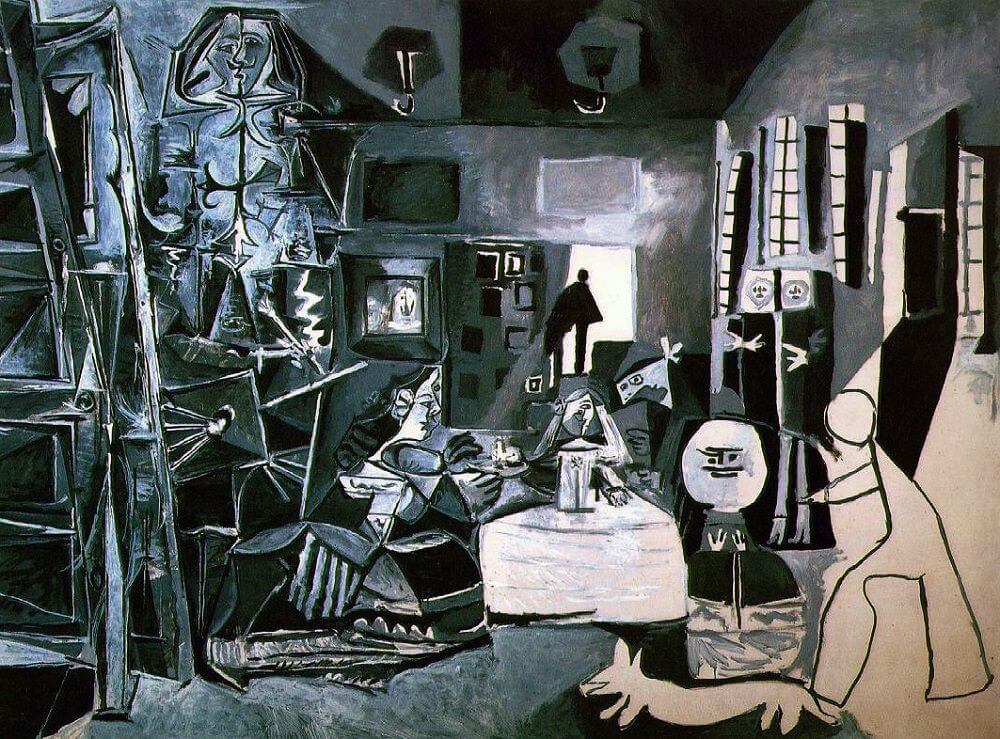
It is difficult to separate the appreciation of the second from knowledge of the first. If Picasso’s painting ‘works’, it works as a ‘comment on’ Velasquez. (Another comparison that is interesting: Manet’s Olympia as a ‘comment on’ or ‘twist on’ Titian’s Venus of Urbino. We might just see two reclining nudes, but appreciating the relation between the two makes the appreciation of the second that much, I think, richer.)
Does that mean it isn’t or can’t be ‘beautiful’? The strict interpretation outlined a moment ago says it can’t be, or it can’t be as a comment on Velasquez. But Gadamer claims Kant’s “examples of free beauty are obviously not intended to exhibit beauty proper, but only to insure that pleasure as such is not a judgment of the perfection of the object” (p. 41). We might instead speak of a compatibilism of (i) the experience of pleasure in reference to a work of art with (ii) its adherent or dependent status, rather than a determination. Wherever “‘looking to a concept’ does not abrogate the freedom of the imagination,” aesthetic beauty remains a possibility (p. 41). “Without contradicting himself, Kant can describe it as a legitimate condition of aesthetic pleasure that there is no conflict with purposive elements” (ibid.). See further the passage highlighted on p. 41.
4 §17
Gadamer thinks something happens in §17 that challenges the strict interpretation. Kant begins §17 stating “there can be no objective rule of taste,” since beauty is aesthetic (i.e., sensible) (CJ p. 79). But “the universal communicability” of aesthetic pleasure suggests there is a “deeply hidden basis, common to all human beings, underlying their agreement in judging the forms under which objects are given them” (ibid.). Are there therefore “archetypes of taste,” ideas of what counts as beautiful that transcend local and specific schemas and instances?
Such an ideal of beauty would be “fixed by a concept of objective purposiveness” (CJ p. 80). Why? Recall that pleasure is purposive: It is a reason why we continue in some activity. When we say something is beautiful, we mean for Kant that it is subjectively purposive: The pleasure we experience in sensing it is the reason why we continue to sense it. Something that arouses the same reaction in all of us would have to be purposive not only for me but for all of us. But this sort of ideal is “unthinkable” in reference to the usual objects of awareness, which includes natural as well as artificial things.
Kant thinks however that there is a human ideal that is objectively purposive.
This leaves only that which has the purpose of its existence within itself-man. Man can himself determine his purposes by reason; or, where he has to take them from outer perception, he can still compare them with essential and universal purposes and then judge the former purposes’ harmony with the latter ones aesthetically as well. It is man, alone among all objects in the world, who admits of an ideal of beauty, just as the humanity in his person, [Le., in man considered] as an intelIigence, is the only [thing] in the world that admits of the ideal of perfection. (CJ p. 81)
The ideal of the beautiful here is not just a “standard idea” of what a human looks like. Rather:
the ideal in this figure consists in the expression of the moral; apart from the moral the object would not be liked universally and moreover positively (rather than merely negatively, when it is exhibited in a way that is [merely] academically correct). (CJ pp. 83-84)
What matters for Gadamer about this ideal is that it is not imposed on an appearance (i.e., on an artistic representation of a human). This ideal creates a different sort of relation between the work of art and the viewer than that between object (in nature) and cognizing subject. See p. 43.
Let me see if an example will help us appreciate this and expand it. Consider Caravaggio’s Denial of Saint Peter. What I want us to notice is how, initially, the ‘triangulating’ mechanism
viewer \(\rightarrow\) work \(\rightarrow\) object
works differently here than it does in the case of a representation of an apple or a church. We don’t relate the work to an object in a determinate sense; we sympathize with the character in reference to moral ideals and the complex relationship being human has to them. Have you ever done something to save your hide, even though it violated your deepest moral beliefs? Then you know what Peter is going through here. The ‘human ideal’ for Kant is objective inasmuch as reason is objectively determinate of freedom and morality.
Now consider Cézanne’s Basket of Apples. ‘Objectively’ as it were this is the counterexample: things that for Kant can have no objective standards of beauty. But I want to draw your attention to just one detail of the painting, and it’s the back of the table. The painting is, sure, in one sense a representation of apples in a basket and so on. It is also a representation of human perception. The dark outlines of the fruit, too, show things we ‘know’ aren’t there but that our mind projects onto experience. The Basket of Apples can be seen as exemplary of the way our minds shape rather than receive sensible appearances. In other words, the human is the subject of the painting, not apples.

Now, in that way, as Hegel claims, art is always human in its orientation. As an aesthetic object, art has “an advantage . . . over natural beauty: the advantage of being a more direct expression of the moral” (p. 44). But the concern for the moral informs the aesthetic value of natural beauty, too. See p. 44. Hence, inversely, the aesthetic quality of nature derives from its serving as a sort of “confirmation” of ourselves “by another”; see p. 45.
In Kant’s view, art is too artificial, too actually designed, to occasion the ‘free play’ of the imagination and the understanding that is characteristic of the experience of beauty. The fact that it nevertheless does seem to engage the imagination and the understanding in that way should, Gadamer thinks, be regarded as remarkable. See p. 45 green.